Many of you are now tired of listening to me talking about the old Neualtenburg Projekt (yes, with a K, to use the German spelling), currently known as the City of Neufreistadt, and about several of its aspects. While it is not a “city” — a better description, due to its size and population, would be a “hamlet” — it incorporates several things that people associate with a “city”. The urban planning and a City Council are, of course, two of the best-known aspects of Neufreistadt. Recently, the financial aspect of it has been discussed, regarding bonds and other financial products that a City could offer to potential investors. I expect that, as time goes by, and Neufreistadt successfully explores these and other issues, it will “resemble” a RL city more and more, in all that it has to offer.
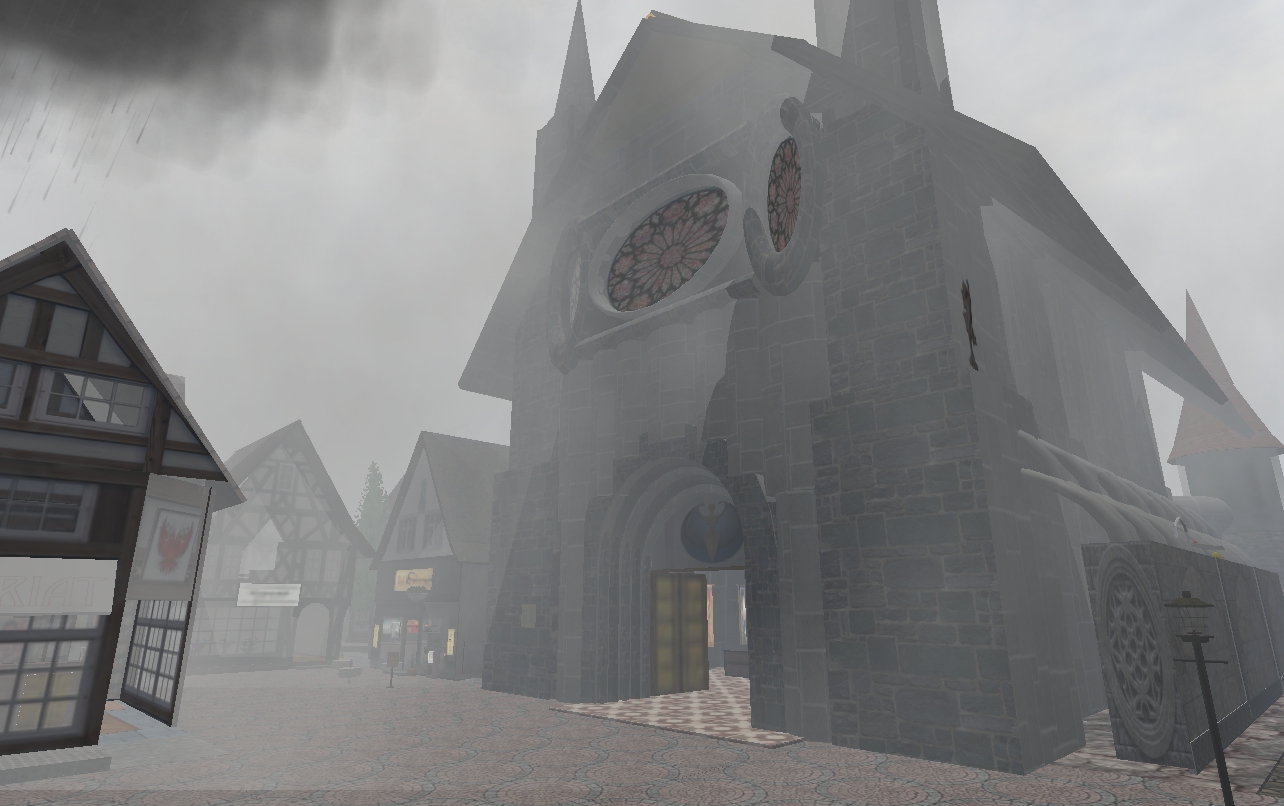
One of the things that intrigued me since the beginning was Ulrika’s original proposal including a “church” and expecting “non-denominational” religious/spiritual meetings to be held there. After a few false starts (we got some volunteers for running the events but that never showed up when the city was finished), it was my time to try to do something 🙂
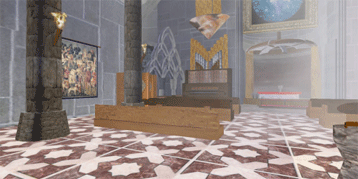
Right now, you have in SL a few “preacher” and “tele-evangelist” types holding pseudo-Christian events, here and there, and, of course, lots of small communities meeting in-world, like Paganists, Wiccans, and to a much lesser extent, Taoists and other Oriental spiritual philosophies. In a sense, SL has openly embraced all the multitude of religious groups, and it’s true that usually religious groups attract regular attendance, or so it has been reported. Thus, my first step was to devise a model of “meetings” that would appeal to all, making sure that no one was left behind, and try to emphasize the common cultural heritage, instead of concentrating on this or that aspect of a particular religion. The purpose was not to do “comparative religion”, but to set up a place where different belief systems could find a “common ground” of discussion.
Now, I must obviously explain to everybody who attends that I’m not a religious priestess, teacher, catechist, minister, or whatever you may call an “event hoster” on religious meetings. I’m not even formally trained as a philosopher (although I certainly studied a bit of philosophy, both at high school and later). Hosting a “universal” meeting on religion without formal training is not something to be done lightly. Also, I would certainly desire to achieve a degree of conversation, of inspiring and provoking thoughts, of self-challenging common assumptions and misbeliefs, and keep people focused on spiritual guidelines that are valid for each and every religion, in spite of so many “alleged” differences.
My only help was my ongoing research and reading of Esoteric Christianism. Being raised as a Roman Catholic, it’s not unsurprising that, after some deep thinking, I naturally embraced my own spiritual path, following the teachings of many esoteric Christians, although I tend to concentrate always on the “message” and almost never on the weird concepts related to their cosmogeny. One of my “spiritual guides”, if I may call him that, once told me that this cosmogeny only makes sense to an Enlightened one; that may very well be true, but I’m definitely many years away from that goal, which I highly likely will never attain. Thus, I kept to the more mundane teachings. They’re universal enough to appeal to any religious/spiritual background (one common view of esoterism is that ultimately all paths ascend the same mountain, and that when you are at the summit, no matter what path you chose, the answers will be precisely the same).
Since it’s hard for me to research a new topic every week, and as attendance is low (around half a dozen people), I’ve kept to a “series” of meetings, always on the same topics. Since people also change every time, there is always an undiscovered angle that can be approached, especially when you have people around with very different religious backgrounds. I think that always make the discussions more interesting!
A common disclaimer is at the beginning of each meeting — that I’m no minister or priestess, and that I’ll try to avoid preconceptions like “God” (since many religions replace that concept with things like Gaia/Universe or The Stream of Consciousness). Sometimes, sadly, I cannot fully escape my own background and inevitably fall back to these terms, although the essence stays the same, people will only need to replace the metaphysical concepts with ones they’re more comfortable with.
A common guideline to the meetings are based on the following concepts:
- All human beings are “tuned” to religious belief; some exercise it, some don’t; the ones that don’t very often believe as strongly that “nothing exists out there”.
- Humankind is a gregarious species. Unlike other predators, we have no choice but to work together, form units of collaboration beyond the family and clan, and we need to organize ourselves accordingly. Religion reinforces the social rules to make us keep the altruistic and egoistical aspects of our nature in check, for the common good.
- Ignorance is the major reason for suffering (but like any good Buddhist would tell you, the first step is to recognize that suffering does in fact exist, and that there are ways to reduce suffering).
- We have free will (this is one of the most fundamental premises).
- A religious path is something that you have to choose to follow. Among the way you may find fellow travellers and even some good guides. But you can’t be forced to travel a path it you don’t wish to.
- Holy writings usually capture the essence of basic teachings quite well. The trouble is to understand them. Most are so incredibly simple to understand (and even easier to follow) that sometimes we feel disappointed about the simple-mindedness of some religious authors (in other words, “understanding the Trinity” is not supposed to be so important for a Christian as focusing on the key message of compassion towards fellow human beings).
To the above I usually add that it’s harder to follow a rational path (the occult way) than an emotional one (the mystic way). But that, of course, is simply due to my own limitations.
The series, loosely described, go like this:
Praying
Several religions teach praying as a form of getting attention or favours from their deities. Believers are encouraged to several forms of praying to appease their deities and in a sense to measure their “status” towards them.
However, this is a certain fallacy. A common example shows the problem with this type of praying. Two tennis players, very devout believers, pray to their deities to win the game next day. But only one will win. So, the loser will ask of himself what he did to displease the deity, while the winner will be happy because he stood in favour with his own deity. This, of course, is mightily unfair.
As a matter of fact, praying can’t interfere with people’s lives. To understand that, we’ll have to tackle with free will, the deity’s most precious gift. The deity cannot “force” its own will upon us (that would mean depriving us from our own free will), so it has to remain silent and not interfering.
So, prayer should be used for two things: one simple, one complex. The first one is just praising the deity (or the Universe, or the Stream of Consciousness…). The second one, instead of “asking” or “demanding” things, is simply to listen.
Free Will
This is just a discussion around free will. It’s hard to dismiss old superstitions like “fate” or “destiny”. None of these are “compatible” with free will, so the discussion usually explores the differences between those concepts.
Sometimes we explore the reason why the deity cannot interfere in this world.
Good vs. Evil
Human beings are gregarious by nature — although many claim to be able to live as hermits, the truth is, only a tiny minority of people can live as “true hermits”, due to living within the comforts of a modern, technological society.
So, simply stated, “good” is anything that benefits a community, while “bad” are the things that break a community apart. Overall, in the world, most social rules encourage positive behaviour towards the community, so it’s not unsurprising that most “definitions” of “good” tend to overlap.
Humankind’s First Task
Positivists these days claim that there is no place for religion, and that science is the actual opposite of religions. Well, interestingly enough, the first job that Humankind got from God in the Bible was: “name my creation”.
This is usually dismissed for the much more interesting Second Job — procreation. But what means “naming creation”? Well, one possible explanation is watching the Universe, observing its interactions, cataloguing them, and trying to make sense out of them. Sounds familiar? These are the guidelines for a scientific system.
So, it seems that the authors of Genesis wrote down that Humankind’s first job is… to become scientists 🙂 (and then, of course, procreate 😀 )
The Afterlife
This is where we try to use an analogy. Imagine an artificial intelligence in Second Life, which interacts with the rest of the humans. This AI sees that we disconnect often but come back all the time without any apparent loss. If the AI asks us directly: “where do you go when you’re offline?” our answer is that we don’t really go anywhere. As human beings, we exist in two worlds simultaneously: the physical world, where we have flesh and blood; and the virtual world, where we have a pixelized avatar. So, we are “the same being”, but, using this clever “interface between worlds” called SL, we can also be in a “different” place at the same time.
I think that the “afterlife” is just that — a “different” place which we can’t understand, but where we’ll be “the same”, just… different.
Esoterism: the occult way and the mystic way
Just to clear up a bit of name definitions here. “Occult” does just mean going through a rational, learning process. “Mystic” is a process of sudden enlightenment. Esoterism is the study of the meaning behind the words and symbols.
These should be good starting points 🙂