


Gynopisces nympha, commonly known as the tropical mermaid or reef siren, is a species of sapient marine primate native to shallow coral reef ecosystems and tropical coastal waters. Characterised by a mammalian upper torso and a highly modified, leg-derived piscine lower caudal region, the species has occupied a prominent place in global maritime folklore. Modern biological consensus places them under the family Hominidae (or a sister group Hydrohominidae), identifying them as a divergent aquatic branch of the primate lineage.
Nomenclature and Etymology
The binomial name Gynopisces nympha derives from classical Greek and Latin roots, translating literally to “maiden woman-fish”.
- Genus (Gynopisces): A hybrid compound of the Greek gynē (γυνή), meaning ‘woman’, and the Latin piscis, meaning ‘fish’.
- Species (nympha): From the Latin nympha (originally Greek nýmphē), denoting a young, beautiful maiden or nature spirit associated with water and woods.
Pronunciation
- IPA: /ˌdʒaɪnoʊˈpɪsɪs ˈnɪmfə/
- Phonetic: JY-noh-PISS-iss NIM-fuh
Taxonomy and Evolution
Initially dismissed as a myth born of sailor fatigue and manatee misidentifications, G. nympha was formally catalogued into taxonomic literature in the late 19th century.
Kingdom: Animalia
Phylum: Chordata
Class: Mammalia
Order: Primates
Suborder: Haplorhini
Infraorder: Simiiformes
Superfamily: Hominoidea
Family: Hydrohominidae (or Hominidae)
Genus: Gynopisces
Species: G. nympha
Evolutionary Origins
Fossil records discovered in maritime limestone deposits suggest that Hydrohominidae diverged from the common primate ancestor during the late Miocene epoch, approximately 7 to 10 million years ago. While ancestral land primates adapted to bipedalism on the African savannah, a localised population adapted to a semi-aquatic lifestyle in shifting coastal shorelines.
                  +--- Homo (Land Bipedalism)
                  |
Common Ancestor --+
                  |
                  +--- Hydrohominidae / Gynopisces (Aquatic Fusion)
Unlike cetaceans (whales and dolphins) and sirenians (manatees), which evolved their flukes from highly modified tails while minimising their hind limbs, humans and other great apes have no true tail structure. Consequently, G. nympha underwent a unique evolutionary track: their ancestral legs progressively rotated inward, fused down the midline over millions of years, and hypertrophied into a dense, muscular caudal peduncle. The feet transformed into a homocercal-style caudal fin. This mirror-imaged bipedal thrust matches the swimming motion human divers use when performing a dolphin kick but is executed with dedicated, powerful aquatic musculature.
Anatomy and Physiology
The species exhibits striking sexual dimorphism and highly specialised adaptations for paradisiacal, shallow-water environments.
Upper Body and Camouflage
The upper torso closely mirrors human female anatomy, though reinforced with a dense layer of subcutaneous blubber for buoyancy. The epidermis lacks scales but possesses chromatophores that allow subtle colour shifting to mimic the shifting turquoise and emerald hues of sunlit tropical beaches.
Caudal Region
From the pelvis down, the body tapers into a powerful, muscular caudal peduncle covered in iridescent cycloid scales. The caudal fin is homocercal, resembling that of large pelagic reef fish, allowing for immense bursts of speed over short distances to navigate complex coral labyrinths.
Respiratory System
G. nympha features a highly specialised dual-respiratory apparatus unique among mammalian species. While retaining highly vascularised lungs for breathing atmospheric air, the thoracic cavity features a series of internal gill-slits concealed beneath specialised muscular folds along the lower neck and upper back.
This system operates via a counter-current exchange mechanism, allowing the mermaid to extract dissolved oxygen directly from water when submerged. When breaching the surface, a series of sphincters close off the gill chambers, and respiration shifts entirely to the pulmonary tract.
Genital Anatomy and Reproductive System
Anatomically, G. nympha is fully mammalian. The secondary sexual attributes (highly developed breasts) serve both as milk-producing mammary glands and social markers.
To cope with high hydrostatic pressure, dragging friction, and marine microparasites, the female external genitalia are tucked into an internal urogenital cleft located ventrally on the lower abdomen, precisely where the smooth skin transitions to iridescent cycloid scales. This cleft is shielded by a specialised, voluntary muscular fold—often reinforced with thin, flexible, scale-like structures. This operates similarly to a dolphin’s urogenital slit, opening at will for urinal relief or reproductive purposes.
Unihemispheric Slow-Wave Sleep
To survive in open water without drowning or falling prey to reef predators, G. nympha exhibits unihemispheric slow-wave sleep. They sleep with only half of their brain at a time while the other half remains conscious to control breathing, maintain neutral buoyancy, and scan the surroundings for threats. This behaviour gave rise to the historic mariner myth that “mermaids never sleep”.
Sunbathing and Vitamin D
Because an aquatic diet lacks certain essential sterols, the species relies heavily on basking on exposed coral heads, sandbars, and rocks during low tide. This behaviour is a biological necessity for synthesised vitamin D production, which supports bone density in their powerful skeletal structure.
Voicing and communication
Gynopisces nympha uses low-frequency melodic singing and infrasound, often via the ocean’s SOFAR channel, to communicate over long distances, bypassing surface noise. While high-frequency clicks are restricted to short-range navigation, these structural vocalisations are used for transferring information and creating warning songs about human activity. For more details, visit NOAA’s National Ocean Service.
Habitat and Distribution
G. nympha is strictly restricted to warm, tropical marine ecoregions. They are most commonly observed in:
- Shallow lagoons
- Fringing coral reefs
- Secluded, crystal-clear sandy beaches
They require water temperatures above 22°C (71°F) and are highly dependent on healthy coral structures for shelter, foraging, and communal nurseries.
Behavior and Temperament
Field observations describe G. nympha as an inherently peaceful yet highly temperamental species.
   PEACEFUL STATE                      TEMPERAMENT TRIGGER                  DEFENSIVE STATE
+--------------------+               +---------------------+             +--------------------+
|  Cooperating with  |  ==========>  |  Territorial Breach |  =========> | Fast, Aggressive   |
|   Reef Ecosystem   |               |   or Aggression     |             |  Flanking Tactics  |
+--------------------+               +---------------------+             +--------------------+
Code language: PHP (php)
Social Structure
They live in loose, matriarchal communities known as clans. They display high emotional intelligence, complex vocal language (consisting of clicks, whistles, and melodic harmonic tones), and a playful curiosity toward land-dwelling organisms.
The ‘Siren’ Temper
While typically passive and content to sunbathe on exposed reefs, G. nympha possesses an unpredictable, fierce protective instinct. If their territory is breached or their pod is threatened by maritime vessels, their demeanour shifts rapidly. They utilise coordinated flanking tactics, using their powerful tails to churn water or strike hull structures, and deploy piercing, high-frequency acoustic vocalisations capable of disorienting human divers.
Behavior, Culture, and Tool Use
Tool Use and Personal Adornment
G. nympha exhibits advanced tool usage, primarily utilising marine resources to create functional and aesthetic objects.
- Combs and Mirrors: Carved out of dense tortoiseshell, bivalve shells, or scavenged hardwood. Combs are used to prevent kelp tangles and parasites from taking root in their long hair.
- Jewellery: They construct necklaces, bracelets, and waistbands utilising polished pearls, drilled coral beads, and segments of colourful sea glass, which indicate social status within a clan.
       SHELL/WOOD MATERIAL              MANUFACTURING                FUNCTIONAL TOOL
+-------------------------------+     +--------------------+     +------------------------+
|  Tortoiseshell / Sea Glass    | ===>|  Hand-Carving with | ===>| Combs, Aesthetic       |
|  Drilled Coral / True Pearls  |     | Shark-Tooth Chisels|     | Mirrors, Coral Jewelry |
+-------------------------------+     +--------------------+     +------------------------+
Code language: PHP (php)
Oral Tradition and Music
Because underwater environments preclude the development of paper or traditional writing, G. nympha maintains an extensive oral history preserved entirely through song. They possess complex vocal cords capable of layered harmonics. Clans frequently gather in underwater caverns to sing epics, sometimes accompanying themselves by plucking resonant, dried kelp strands or turtle-shell harps.
- Content of Songs: Their repertoire includes historical genealogies, migratory maps, and warning tales. A large portion of their modern oral tradition consists of cautionary songs regarding Homo sapiens. These melodies describe the dangers of fishing nets, large boat propellers, and terrestrial pollution, instructing younger pod members to avoid human vessels.
Mating and Reproduction
Due to their close phylogenetic proximity within the primate order, G. nympha shares several reproductive behaviours with land-dwelling primates, including a preference for face-to-face mating (ventro-ventral positioning), a trait shared significantly with bonobos and humans.
Hybridization vs. Myth
While historical lore frequently speculates about physical intercourse between human sailors and mermaids, actual biological hybridisation is an impossibility due to chromosomal incompatibility. Merfolk populations are fully self-sustaining. The male counterpart of the species (often colloquially termed tritons) possesses matching mammalian adaptations, ensuring internal fertilisation. They do not lay eggs; G. nympha carries their young internally through a nine-month gestation period, giving birth to live young underwater.
Habitat, Conservation, and Climate Adaptation
Traditional Range and Indigenous Cults
Historically, G. nympha populations were densely concentrated throughout warm, tropical coral reef systems, establishing deep cultural ties with local human populations:
- The Caribbean: In pre-Columbian Taíno culture, they were integrated into animistic belief systems as guardian spirits of coastal waters.
- Indonesian Archipelago & Melanesia: Coral reef populations were respected by local seafaring communities, who enforced strict taboos against fishing in specific lagoons where the “sea maidens” nested.
Environmental Law Enforcement
Clans protect their habitats through non-magical, highly effective tactical disruption. If a human fishing vessel or polluter enters a protected reef, the clan uses coordinated acoustic screeches to induce vertigo in human divers, cuts fishing lines with sharp stone tools, and purposefully wedges large coral blocks or debris into ship rudders to force vessels away.
Conservation Status and Climate Shift
Currently, G. nympha is classified as a Critically Endangered species due to widespread coral bleaching, ocean acidification, and the destruction of shallow coastal lagoons. However, they have shown remarkable behavioural plasticity in response to climate change.
   CORAL BLEACHING                  HABITAT SHIFT                    HABITAT MODIFICATION
+--------------------+               +---------------------+             +--------------------+
| Loss of Tropical   |  ==========>  | Migration to Warmer |  =========> | Aquaculture,       |
| Reef Environments  |               | Northern Latitudes  |             | Kelp Herding,      |
+--------------------+               +---------------------+             +--------------------+
Code language: PHP (php)
As sea temperatures rise, some clans have begun migrating further north and south into expanding warm-water zones. To adapt to areas lacking natural coral structures, these displaced populations have turned to advanced underwater agriculture and aquaculture:
- Kelp Herding: Cultivating dense, vertical kelp forests to block heavy maritime trade lane currents.
- Fish Farming: Building low-stone marine pens to herd and breed local fish populations.
- Artificial Reef Adoption: When humans deploy artificial concrete structures or sink vessels for reef rehabilitation, G. nympha communities will actively colonise the sites within weeks, using their tool-use skills to weave protective flora and maximise the artificial habitat’s yield.
Historical Documentation and Chronology
The integration of Gynopisces nympha into human history is a complex tapestry of mythological exaggeration, colonial misidentification, and tragic exploitation. Below is the official historical timeline of documented encounters, compiled from classical antiquity to modern marine biology.
Historical Chronology
   ANTIQUITY                  1493 (COLUMBUS)             18th CENTURY (ASIA)            1976 (SOFAR)
+--------------+             +-----------------+        +---------------------+        +--------------+
| Tritonian    |  ========>  | The Manatee     | ====>  | The Ningyo Oil      | =====> | First Navy   |
| Cults        |             | Misdirection    |        | Crisis              |        | Audio Capture|
+--------------+             +-----------------+        +---------------------+        +--------------+
Code language: PHP (php)
4th Century BCE: The Tritonian Diplomatic Accords (Greece)
Aristotle’s lost journals De Rebus Maritimis contains the earliest academic attempts to separate G. nympha from the bird-like Sirens of Homeric myth. He documents a stable population in the Aegean Sea, noted for their worship of a massive, male hominid elder whom locals named Triton.
The ancient Greeks established a sacred maritime taboo: ships carrying olive oil or wine were forbidden from dumping bilge water near shallow reef grottos. In exchange, the Gynopisces clans used their underwater acoustic navigation to guide lost triremes away from jagged shallow rocks during summer storms.
1493: The Columbus Misdirection (The Caribbean)
On January 9, 1493, sailing near the Dominican Republic, Christopher Columbus logged the infamous sighting of three ‘mermaids’ that “rose well out of the sea”. He noted with disappointment that they were “not as beautiful as they are painted, though to some extent they have a human face.”
Modern zoological analysis confirms Columbus did not see G. nympha. Instead, he encountered a pod of West Indian manatees (Trichechus manatus). G. nympha clans, highly sensitive to the low-frequency thrum of heavy European wooden hulls, had already retreated into the deeper, protective maze of the inner coral reefs to avoid the explorers.
       COLUMBUS LOG (1493)                   ACTUAL VISUAL CONTEXT
+-------------------------------+     +--------------------------------+
| "Not as beautiful as painted" | ===>| West Indian Manatee            |
| "Ugly, human-like face"       |     | (Trichechus manatus)           |
+-------------------------------+     +--------------------------------+
Code language: PHP (php)
1720–1785: The Pearl Tear and Ningyo Oil Crisis (East Asia)
During the Edo period in Japan and the Qing Dynasty in China, regional sub-species of Gynopisces (referred to in local lore as Ningyo or Jiaoren) faced a catastrophic ecological bottleneck.
- The Pearl Myth: Court alchemists spread the rumour that the calcified, pearl-like beads worn as jewellery by the mermaids were actually tears that solidified upon leaving their eyes.
- The Thousand-Year Oil: Whaling fleets actively hunted coastal Gynopisces pods for their specialised, thick subcutaneous blubber layer. The refined oil burnt with unprecedented clarity and minimal smoke, allegedly lasting “for a thousand years”.
This period of aggressive commercial exploitation drove the western Pacific populations to near-extinction, forcing the surviving clans to abandon coastal waters entirely and adapt to deeper, nocturnal lifestyles.
1976: Project SOFAR and the “Siren Symphony”
During the height of the Cold War, the U.S. Navy’s Sound Surveillance System (SOSUS) picked up an anomalous, highly structured acoustic signature echoing through the deep-ocean SOFAR (Sound Fixing and Ranging) channel.
Initially feared to be a new class of silent Soviet submarines, the audio files—later leaked as the “Siren Symphony”—revealed complex, three-part harmonic structures. The hydrophone arrays captured an oral historical epic being passed down across thousands of miles from a clan in the Caribbean Sea to a displaced population near the Indonesian Archipelago, warning them of expanding deep-sea industrial shipping lanes.
Global Cultural Interpretations
The Taíno Culture (Pre-Columbian Caribbean)
In the Caribbean, the native Taíno people revered G. nympha as Atabeyra, a maternal deity of moving waters, tides, and coral fertility. Because the mermaids were observed aggressively defending the shallow reefs from overfishing using sharp stone chisels, the Taíno viewed them as active environmental lawmakers. Fishing in a Gynopisces-inhabited lagoon without a spiritual offering of fresh fruit or cassava bread was believed to invite sudden, violent squalls generated by the “sea maidens'” defensive splashing.
The Indonesian Archipelago & Melanesia
In the coral-rich waters of the Coral Triangle, indigenous animistic traditions viewed the merfolk as ancestral guardians. Local shamans claimed the ability to interpret the low-frequency vibrations humming through the hulls of their outrigger canoes. If the ‘singing’ turned sharp and rapid, it was an infallible indicator that a tsunami or severe tropical cyclone was approaching, allowing coastal villages hours of advanced warning to evacuate to higher ground.
Modern Geopolitical Status and Geohistorical Context
Modern Geopolitical Status and Legal Precedents
As sentient, sapient hominids possessing high emotional intelligence and complex linguistic structures, Gynopisces nympha has increasingly moved out of the domain of maritime wildlife conservation and into international human rights law. The modern legal framework treating G. nympha not merely as a Critically Endangered Species but as environmental refugees and asylum seekers represents a major shift in 21st-century global governance.
   CLIMATE DISPLACEMENT              GEOPOLITICAL BARRIER                 PROJECTED CRISIS
+-----------------------+         +-------------------------+         +-----------------------+
| Bleached Tropical     | ======> | Black Sea Minefields /  | ======> | Ecological Shock &    |
| Reef Habitats         |         | War Zone Disruptions    |         | Forced Assimilation   |
+-----------------------+         +-------------------------+         +-----------------------+
Code language: PHP (php)
The Balkan Lake Initiative and the Black Sea Bottleneck
Following the escalation of ocean acidification in the Mediterranean, a coalition of land-locked Balkan states—led by the republics of Syldavia and Borduria—pioneered a progressive humanitarian initiative. Backed by local charities, these nations officially designated several deep, inland alpine lakes as sovereign humanitarian reserves for displaced Gynopisces clans.
However, this sanctuary pipeline faces severe geopolitical and biological roadblocks:
- The Black Sea Bottleneck: The only viable migratory entry point to reach the river networks of Syldavia and Borduria is through the Black Sea ports. Ongoing regional warfare and military conflicts have completely disrupted all safe passage.
- The Weaponisation of the Coastline: International NGOs attempting to map aquatic migratory corridors have reported that the dense deployment of naval sea mines, anti-submarine sonar sweeps, and localised littoral warfare make the Black Sea impassable. Mermaids deliberately avoid the route due to the agonising acoustic trauma caused by underwater detonations.
- The Ecosystem Displacement Dilemma: Even if a clan successfully navigated the war zone, scientists question whether G. nympha could survive long-term. As a species evolutionarily optimised for warm, high-salinity, tropical coral ecosystems, adapting to the freezing, brackish, or purely freshwater environments of Balkan lakes requires a complete restructuring of their lifestyle. This displacement mirrors the historic 19th-century forced relocations of Native American populations, where indigenous peoples were systematically pushed into geographically hostile reservations devoid of their traditional flora and fauna, leading to catastrophic cultural and physical decline.
Exploitation in the Americas (San Theodoros and Nuevo Rico)
In contrast to the land-locked Balkan options, equatorial Latin American nations like the republics of San Theodoros and Nuevo Rico offer ideal geography, featuring open migratory routes linking both the Atlantic and Pacific oceans directly to pristine tropical bays. Regrettably, widespread bureaucratic corruption and economic instability have transformed these potential havens into centres of human rights abuse:
- The Commercial Poaching Resurgence: In both San Theodoros and Nuevo Rico, early Gynopisces asylum seekers were systematically hunted by local cartels. Driven by black-market demand, poachers harvested their subcutaneous fat layer for “snake oil” cosmetics and extracted their calcified jewellery under the false pretence of medicinal “magic properties”.
- The Amusement Park Tragedies: A small number of surviving mermaids were temporarily granted asylum under corporate sponsorship, forced to work in commercial water amusement parks as local tourist attractions (e.g., “Watch a Real Mermaid Herding Dolphins!”). These operations ended in bloodshed when radical political fanatics, attempting to “debunk” the reality of the sapient anomalies, launched armed raids on the parks. Asserting that the mermaids were merely human actors stitched into prosthetics, the attackers systematically mutilated the captives to “remove the fish parts”, resulting in the deaths of the innocent hominids. The horrific aftermath of these slaughters was immediately weaponised by political factions within San Theodoros to either support or suppress the legitimacy of the sitting regime.
International Intervention and UN Proposals
The UN Crisis Cabinet, operating under the auspices of the Sirenian Reef Protection Act, is currently debating several high-stakes strategies to protect the dwindling global population. Each proposed framework carries severe socio-economic tradeoffs:
| PROPOSED POLICIES | POSITIVE IMPACT | NEGATIVE TRADEOFF |
|---|---|---|
| Sovereign Sovereignty Exclusion Zones | Complete protection of critical coral breeding grounds. | Total collapse of regional ecotourism; disruption of maritime trade. |
| Indigenous Warden Enfranchisement | Empowers G. nympha with maritime authority and active sovereignty. | Sparks jurisdictional conflicts with local coastal human navies. |
| UN “Blue Helmet” Artificial Sanctuaries | Immediate military defense against poachers and cartels. | Brain-drain of mermaids from areas actively needing coral repairs. |
- Sovereign Sovereignty Exclusion Zones: This initiative would completely close off recognised tropical reefs to all commercial tourism, civilian maritime traffic, and industrial fishing. While highly effective for habitat regeneration, it faces immense resistance from developing island nations reliant on tourism revenue.
- Indigenous Warden Enfranchisement: This policy proposes replacing human coast guards with localised Gynopisces clans, granting them official legal status as sovereign maritime wardens. The mermaids would enforce local environmental laws using their natural tactical capabilities. However, this creates intense jurisdictional friction with human naval authorities.
- UN “Blue Helmet” Artificial Sanctuaries: The establishment of heavily fortified, militarised aquatic enclosures inside cooperative nations, guarded directly by UN naval detachments. While offering safety from poachers, this creates a severe ecological vacuum: removing G. nympha from their native territories halts their active, hands-on restoration and cultivation of dying coral reefs elsewhere.
Historical Documentation and Chronology
The deep historical record reveals that human-mermaid relations have long been defined by cultural clashes, linguistic curiosity, and religious tragedy.
Excerpt from a 17th-Century Privateer’s Logbook
“14th of May, 1662. Off the coast of the Tortugas.
The lookout did spy what he swore to be three young maids bathing upon a shallow sandspit. Upon our approach, the creatures did not dive as the common seals do, but raised their arms and let loose a series of low, humming whistles that vibrated through the timber of our hull so fiercely it set the men’s teeth to chattering. The quartermaster swears they were casting a hex upon our rudder. Mr. Penrose fired his musket into the surf to disperse them, whereupon the largest of the maids did strike the water with a tail as broad as a stallion’s flank, churning the shallows into a foam that nearly capsized our longboat. They are no beasts, for I saw one wear a band of polished sea-glass about her wrist, fashioned as cleanly as any trinket from the shops of London…”
The Jesuit Mission of San António de la Hispaniola (1684–1691)
The most profound and tragic historical account of early inter-species diplomacy occurred in a secluded, reef-locked bay on the island of Hispaniola. Inspired by the legendary Father António Vieira—whose famous “Sermon of Saint Anthony to the Fishes” in Brazil used the aquatic world to satirise and condemn the brutal enslavement of indigenous peoples—a group of progressive Jesuit priests established the isolated parish of San António.
    JESUIT MISSION (1684)               LINGUISTIC DISCOVERY                COLONIAL MASSACRE (1691)
+--------------------------+         +-------------------------+         +--------------------------+
| Establishment of the     | ======> | Translation of Harmonic | ======> | Parish Burned; Mermaids  |
| San António Parish       |         | Catechisms via Flutes   |         | & Priests Slaughtered    |
+--------------------------+         +-------------------------+         +--------------------------+
Code language: PHP (php)
Led by Brother Bartolomé de Selva, the missionaries rejected the common colonial consensus that the reef-dwellers were mindless monsters. Noting that the local Taíno populations treated the creatures as ancestral judges, the Jesuits set out to convert the Gynopisces clan to Christianity while documenting their culture.
- Linguistic Breakthroughs: The Jesuits discovered that while the mermaids could not replicate human consonants underwater, they could comprehend Latin liturgy when played through specialised wooden flutes that mimicked their native harmonic frequencies. The mermaids, in turn, shared historical songs regarding a “great deluge” that matched biblical narratives, though their verses warned heavily against the greed of the “clothed men from the dry earth”.
- The Martyrdom of San António: The mission’s success proved to be its undoing. Local Spanish plantation owners and superstitious privateers grew terrified of the growing alliance between the Jesuits and the “sea sirens”. Whispers spread through the colony that the priests were teaching the demons how to sabotage Spanish treasure galleons and making diabolical pacts to disrupt the local slave trade.
- In the winter of 1691, an armed mob of colonists and mercenaries descended upon the parish. The church, rectory, and ancestral records were completely burnt to the ground. The missionaries who refused to abandon the bay were executed on the beach. Simultaneously, commercial whaling vessels blocked the reef exits, launching explosive harpoons into the shallows to slaughter the fleeing Gynopisces community. The waters of San António ran red for days, effectively ending the first organised attempt at peaceful coexistence between the two sapient branches of the primate lineage.
Contemporary Geopolitical & Scientific Status Report
1. The Global Rift: The “Sirenian Reef Protection Act” and National Interests
The United Nations Crisis Cabinet’s Sirenian Reef Protection Act has become one of the most polarising pieces of international legislation in modern history. Designed to grant sovereign asylum and habitat protection to Gynopisces nympha, it faces severe resistance from powerful global economic and military factions.
The European Union Deadlock and the Spaceport Diversion
While individual nations—most notably the land-locked Balkan republics of Syldavia and Borduria—are active signatories with designated lake reserves, the European Union as a whole has failed to ratify the charter.
               [ EU COMPROMISE BLOCK ]
                         |
       +-----------------+-----------------+
       |                                   |
[ Industrial Logistics ]         [ Ecological Collapse ]
Maritime transport for           Deep-water reefs near
Guiana Space Centre faces        Guyane are choked by river
costly, lengthy rerouting        pollution; <em>G. nympha</em>
around restricted waters.        clans have fled the area.
Code language: HTML, XML (xml)
The primary blockage comes from France, driven by economic concerns regarding its overseas department of Guyane (French Guiana):
- Logistical Paralysis: The waters surrounding French Guiana host critical deep-water coral systems. Implementing the UN Act would require extensive, costly maritime diversions for heavy transport vessels supplying the Guiana Space Centre in Kourou.
- The Ecological Reality: Ironically, G. nympha clans have already abandoned French Guiana’s reefs due to agricultural runoff and industrial pollution from the region’s rivers, making the French legal filibuster an economic defense of a habitat the mermaids have already forsaken.
The United States Fracture: Activism vs. Exploitation
In the United States, the debate over G. nympha has exposed a deep cultural and economic divide between the states.
   PACIFIC / NEW ENGLAND                      THE GULF SHORE STATES
+---------------------------+             +---------------------------+
| Push for federal treaty   |     VS.     | Dismiss species reality;  |
| ratification and asylum.  |             | defend offshore drilling. |
+---------------------------+             +---------------------------+
Code language: PHP (php)- The Gulf Coast Denial: Texas, Louisiana, Mississippi, and Alabama aggressively reject federal signature of the treaty. State legislators dismiss the sapience of G. nympha, labelling protection efforts for the Gulf of Mexico shores as “anti-capitalist manoeuvres by radical activists designed to halt offshore oil extraction”.
- The Florida Exploitation Model: Florida has adopted a more insidious strategy, exploiting a legal loophole where the status of mermaids as “animals” or “people” remains deliberately ambiguous under state law. Attempting to build upon the commercial entertainment concepts of San Theodoros, Florida developers have drawn up plans for state-sanctioned “mermaid aquaparks”.
- The Disney Lobby: In an unexpected twist, The Walt Disney Company has emerged as a major corporate backer of the UN Siren Act in Florida. Eager to protect its exclusive branding of The Little Mermaid and viewing these live-capture aquaparks as direct competitors, Disney has deployed its massive lobbying apparatus to pressure the state government. Their public campaigns lean heavily into corporate goodwill, stating: “We already have fictitious mermaids providing hours of amusement; we do not need to enslave native G. nympha populations for entertainment.”
2. The Fall of the South American Resistance Movements
The linguistic capabilities of G. nympha are far more advanced than early marine biologists assumed. Because mermaids spend significant time sunbathing on exposed reefs to synthesise Vitamin D, they evolved an “above-water” language utilising air-based vocal cords to shout warnings across sunlit sandbars. Consequently, mermaids can speak human languages with surprising eloquence.
   CLANDESTINE HUMAN ALLIANCE               POPULIST BACKLASH
+------------------------------+       +--------------------------+
| <em>G. nympha</em> speak directly     | ====> | Public dismisses them as |
| with rights activists.       |       | fraud; lynchings occur.  |
+------------------------------+       +--------------------------+
Code language: JavaScript (javascript)
During the rise of the commercial aquarium trade in the equatorial republics of San Theodoros and Nuevo Rico, this shared language allowed captive mermaids to form clandestine resistance networks with sympathetic human activists. However, their ability to speak human tongues triggered a severe backlash:
- The Fraud Accusation: Sceptical populists and corporate entities dismissed their eloquence as a psychological trick or a highly advanced hoax, asking, “How can a fish speak like a man?” Superstitious factions branded the speaking hominids as demonic, echoing 17th-century colonial fears.
- The Crackdown: Armed government forces and corporate security teams systematically dismantled the resistance cells on land. Human allies were labelled “domestic terrorists” or “insane cult members” and sentenced to life imprisonment. Captive mermaids caught on shore were lynched by mobs.
The “Deep Ocean Terrorist” Myth
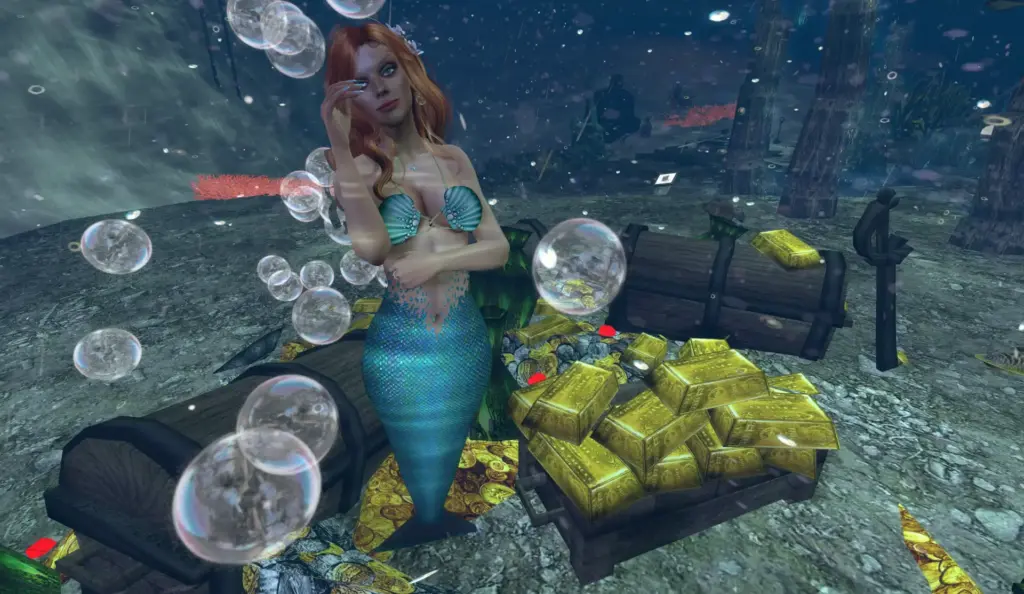
While a few mermaids escaped back into the open sea, the media in San Theodoros continues to spread a popular meme claiming that active, armed mermaid “terrorist cells” are hiding in deep trenches, plotting violent revenge against humanity. In reality, the surviving clans have simply withdrawn from human contact, refusing to trust UN acts or treaties.
On land, the political landscape remains highly volatile. Activists demand the immediate release of their jailed companions, while opponents claim the activists have been “enchanted by siren songs”. Amidst this continuous infighting and bureaucratic corruption, the general population has grown indifferent, leaving the surviving G. nympha populations silent, isolated, and unseen.
3. Cryptanalysis of the “Siren Symphony” and the Marine Web of Trust
   HUMAN AUDIO RECOVERIES                 CETACEAN TRANSLATION
+---------------------------+       +-------------------------------+
| Short, distorted fragments| ====> | Cross-species "Web of Trust"  |
| of SOFAR warning songs.   |       | shared with whales & dolphins.|
+---------------------------+       +-------------------------------+
Code language: JavaScript (javascript)
Because modern G. nympha clans avoid human observation, researchers rely on brute-force audio sweeps of the deep-ocean SOFAR channel. Recent computational analysis of these short, distorted audio captures yielded an unexpected scientific discovery: structural components of the mermaid language directly overlap with the vocal patterns of whales and dolphins.
The Inter-Species Warning Network
Biologists now hypothesise that the ocean contains a cross-species “web of trust”. While the linguistic complexity of a mermaid song is vastly superior to any cetacean vocalisation, G. nympha appears capable of interpreting the long-range acoustic distress signs of whales regarding approaching human vessels. In return, the mermaids broadcast localised warnings back to the cetaceans, helping both groups avoid commercial fishing fleets and sonar arrays.
+---------------------------------------------------------------------------------+

|                        THE OCEAN'S ACOUSTIC WEB OF TRUST                        |
+---------------------------------------------------------------------------------+

|                                                                                 |
|   [ Whale Acoustic Network ]                                                    |
|   - Detects large vessels/sonar at long range.                                  |
|   - Broadcasts low-frequency distress signals.                                  |
|               │                                                                 |
|               ▼ (Interpreted via SOFAR Channel)                                 |
|                                                                                 |
|   [ <em>Gynopisces nympha</em> Clans ]                                                   |
|   - Decodes cetacean data using high-level sapience.                            |
|   - Formulates localized evasion routes and safety protocols.                   |
|               │                                                                 |
|               ▼ (Broadcast back to Marine Mammals)                              |
|                                                                                 |
|   [ Coordinated Oceanic Evasion ]                                               |
|   - Both species systematically avoid active commercial shipping lanes.         |
|                                                                                 |
+---------------------------------------------------------------------------------+
Code language: HTML, XML (xml)
The Jesuit Archive Bottleneck
To build a reliable translation matrix, researchers need more linguistic data. Linguists have turned to the historical archives of the Society of Jesus (Jesuits), seeking the 17th-century linguistic logs compiled at the ill-fated San António Mission in Hispaniola before it was burnt by superstitious colonists.
The investigation has hit a bureaucratic wall:
- The Official Jesuit Stance: The Vatican officially states that the surviving San António records are “incredibly old, highly deteriorated due to centuries of neglect, and completely unorganised.” They claim a systematic restoration process is underway but warn it may take decades before the texts are ready for public release.
- The Historians’ Fear: Independent scholars suspect the Church is intentionally withholding the archives. The fear is that the Jesuits are heavily redacting the historical transcriptions to remove descriptions of mermaid philosophy and language that might challenge traditional theological dogmas, keeping the true nature of humanity’s aquatic cousins hidden behind a wall of religious bureaucracy.